
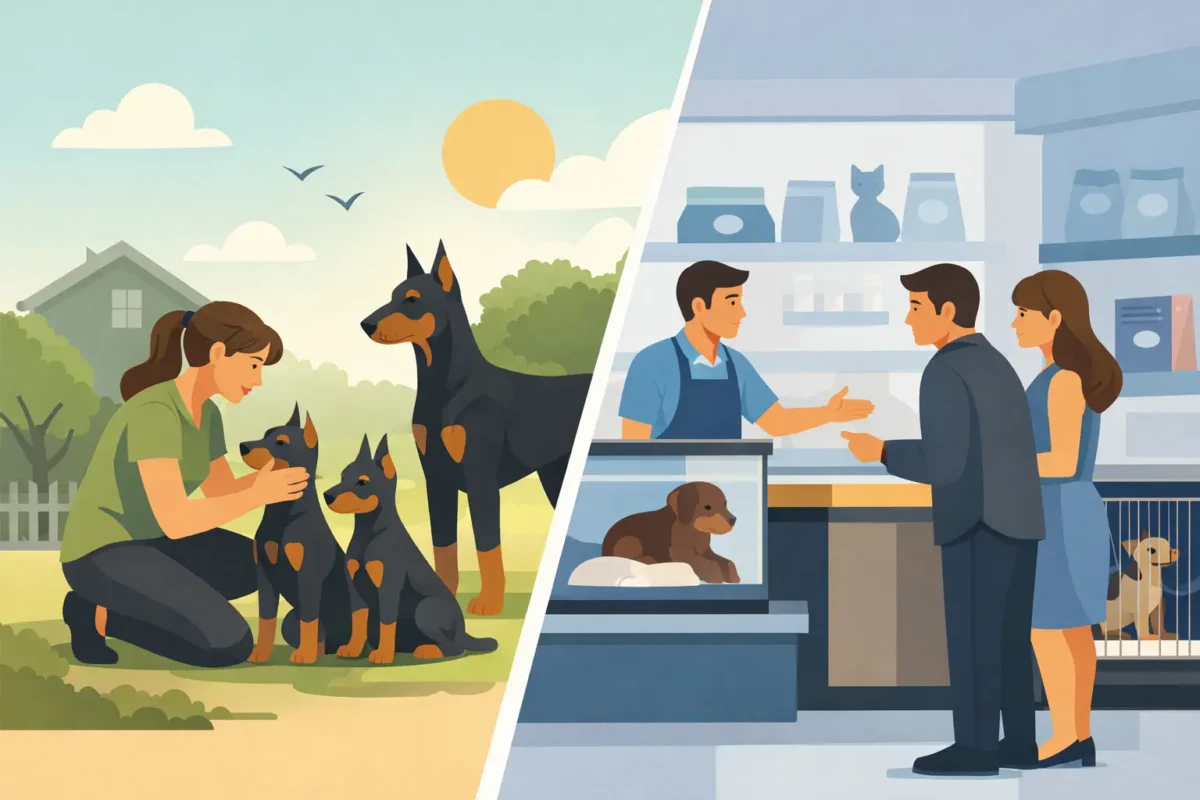
The difference between a doberman breeder vs pet store often shows up long before your puppy comes home – and it can shape your dog’s health, temperament, trainability, and confidence for years. If you want a Doberman that is not only beautiful, but stable, well-started, and purpose-bred for family life, protection, work, or show potential, where that puppy comes from matters.
A Doberman is not a casual breed purchase. This is an intelligent, deeply loyal, highly aware dog with real presence. When bred and raised with care, the Doberman becomes an elegant companion and devoted guardian. When corners are cut, the same breed can become difficult to manage, physically unsound, or emotionally unsettled. That is why buyers comparing a breeder to a pet store are really comparing two very different starting points.
Doberman breeder vs pet store: the core difference
At a glance, both may offer a puppy for sale. That is where the similarity usually ends.
A serious Doberman breeder plans litters around health, temperament, structure, and long-term breed quality. The parents are selected with intention. Health testing is part of the process, not an afterthought. Puppies are raised in a hands-on environment, observed daily, and introduced to early structure and social experiences that support sound development.
A pet store, by contrast, is usually a retail outlet. Its business model is built around availability and convenience. In many cases, the store did not breed the litter, does not know the bloodline in meaningful detail, and cannot speak with breeder-level authority about the pairing, the parents’ working ability, or the long-term goals behind the litter. You may get a puppy quickly, but speed is not the same as quality.
That does not mean every pet store puppy will have obvious issues, and it does not mean every breeder is ethical. It does mean you need to look beyond the sales floor and ask where the puppy truly began.
Why bloodlines matter in a Doberman
With some breeds, buyers focus mostly on looks. With Dobermans, bloodline quality reaches much further. It influences nerve strength, confidence, working drive, trainability, structure, and overall predictability.
A dedicated breeder studies pedigrees because the goal is not simply to produce puppies. The goal is to preserve what makes the Doberman special – power without instability, alertness without chaos, affection without weakness, elegance without sacrificing soundness.
That matters whether you want a family companion, a personal protection prospect, or a dog with show potential. A well-bred Doberman should have a clear mind, strong body, and balanced temperament. A pet store rarely provides that level of breed-specific planning or transparency.
If a seller cannot explain the parents, the line, the health background, and the purpose of the breeding, you are not buying with a full picture. You are buying on hope.
Health testing is not the same as a basic vet check
This is one of the biggest points buyers miss.
Many pet stores advertise that puppies have been vet checked. That sounds reassuring, but a routine exam is not the same as breed-focused health screening. A veterinarian can confirm that a puppy appears healthy on that day. That does not replace thoughtful breeding practices designed to reduce inherited risk.
A responsible Doberman breeder pays close attention to genetic health and uses screening to make smarter breeding decisions. In a breed known for specific health concerns, that level of diligence matters. The best breeders do not rely on luck. They build their program around prevention, documentation, and informed pairing choices.
For a buyer, this can mean fewer surprises and a stronger foundation. Nothing in dog breeding is an absolute guarantee, because living beings are not manufactured products. Still, there is a major difference between a puppy that comes from health-conscious planning and one that simply passed through a retail pipeline.
Early socialization shapes the dog you live with
Dobermans are keenly aware of their environment. They learn fast, respond deeply to people, and are strongly affected by early handling. That is why home rearing and structured socialization are not small details. They are part of what helps a puppy grow into a steady adult.
A breeder who raises puppies closely is watching confidence levels, recovery from new experiences, social engagement, curiosity, and stress response. Puppies are handled, observed, and introduced to age-appropriate stimulation in a deliberate way. This kind of beginning helps build resilience.
In a pet store setting, the puppy’s early weeks may be much less personal. Depending on the source, the puppy may have experienced transport stress, inconsistent handling, limited breed-specific evaluation, or a more generic care routine. For some breeds that may seem manageable. For a Doberman, which thrives on stability and purposeful development, those early gaps can matter.
That does not mean every store-raised puppy will struggle. It means the breeder-raised puppy often comes with more known information and more intentional preparation.
Guidance after the sale is part of the value
A good Doberman breeder is not just selling a puppy. They are making a placement.
That changes the entire relationship. A breeder wants to know whether the puppy is right for your household, your experience level, and your goals. They can talk to you about drive, size expectations, temperament, training approach, and how certain puppies may fit better in active family homes, experienced working homes, or more show-oriented homes.
A pet store employee may be kind and well-meaning, but usually cannot offer that lifetime breed support. Once the transaction is complete, you may be largely on your own.
For first-time Doberman owners, this difference is huge. The breed is loyal and rewarding, but it also benefits from clear leadership, consistency, and informed training. Having breeder support can help you handle everything from crate training and feeding to confidence building and adolescent behavior.
That ongoing connection is one reason many serious buyers prefer a breeder model. At Macson’s Doberman, that long-view approach is part of what gives families peace of mind.
Convenience vs confidence
The biggest advantage of a pet store is convenience. You can often walk in, see a puppy, and make a fast decision. For some buyers, that instant availability feels easier than joining a waitlist or having multiple conversations with a breeder.
But a Doberman should not be an impulse purchase.
When you choose a breeder, the process may take more time. You may need to ask questions, review health information, discuss your home, and wait for the right litter or the right puppy. That extra step can feel slower, but it often leads to much greater confidence.
In other words, convenience helps you get a puppy faster. Confidence helps you choose better.
What to ask before you commit
If you are weighing doberman breeder vs pet store options, ask questions that go beyond price and pickup date. Ask where the puppy was bred and raised. Ask whether the parents are AKC registered and what is known about their health and temperament. Ask how the puppies are socialized, what kind of guarantee is offered, and whether support continues after the sale.
Also pay attention to how the seller responds. A serious breeder should welcome thoughtful questions. They should be able to speak clearly about the line, the litter, and the breed itself. If answers feel vague, rushed, or purely sales-driven, pause.
The right puppy source should give you more than a sales pitch. It should give you confidence in the life you are bringing home.
The better question is not where the puppy is sold
It is easy to frame this as breeder versus store, but the deeper issue is stewardship. Who planned this litter? Who raised this puppy? Who stands behind it? Who understands the Doberman as a breed, not just as inventory?
A well-bred Doberman is a remarkable dog – proud, affectionate, alert, and deeply bonded to its people. That kind of dog does not happen by accident. It begins with responsible decisions long before the puppy meets its future family.
If you are choosing where to begin that journey, choose the source that treats your future companion like a legacy, not a product. That choice tends to reward you every single day after the excitement of bringing a puppy home has passed.
