A polished website can make almost any puppy look exceptional. What matters is what sits behind the photos – the breeding decisions, the health testing, the home environment, and the breeder’s willingness to stand behind every Doberman they produce. If you are researching doberman breeder red flags, you are already asking the right question: not just where to find a puppy, but how to protect your family, your investment, and the future temperament and health of your dog.
A well-bred Doberman should bring together beauty, intelligence, stability, and purpose. This is a powerful breed with a loyal heart and a serious mind. When breeding is careless, the results can be expensive, heartbreaking, and in some cases unsafe. That is why choosing the breeder matters just as much as choosing the puppy.
Why doberman breeder red flags matter so much
Dobermans are not a casual breed. They are deeply devoted, highly trainable, and naturally alert. Those same qualities mean poor breeding shows up quickly. Weak nerves, unstable temperament, structural problems, or inherited health issues can affect everything from trainability to long-term quality of life.
A responsible breeder does more than produce puppies. They plan litters with intention, screen breeding dogs for health, study pedigrees, evaluate temperament, and raise puppies in a way that prepares them for real homes. When those pieces are missing, the warning signs are often visible long before you ever send a deposit.
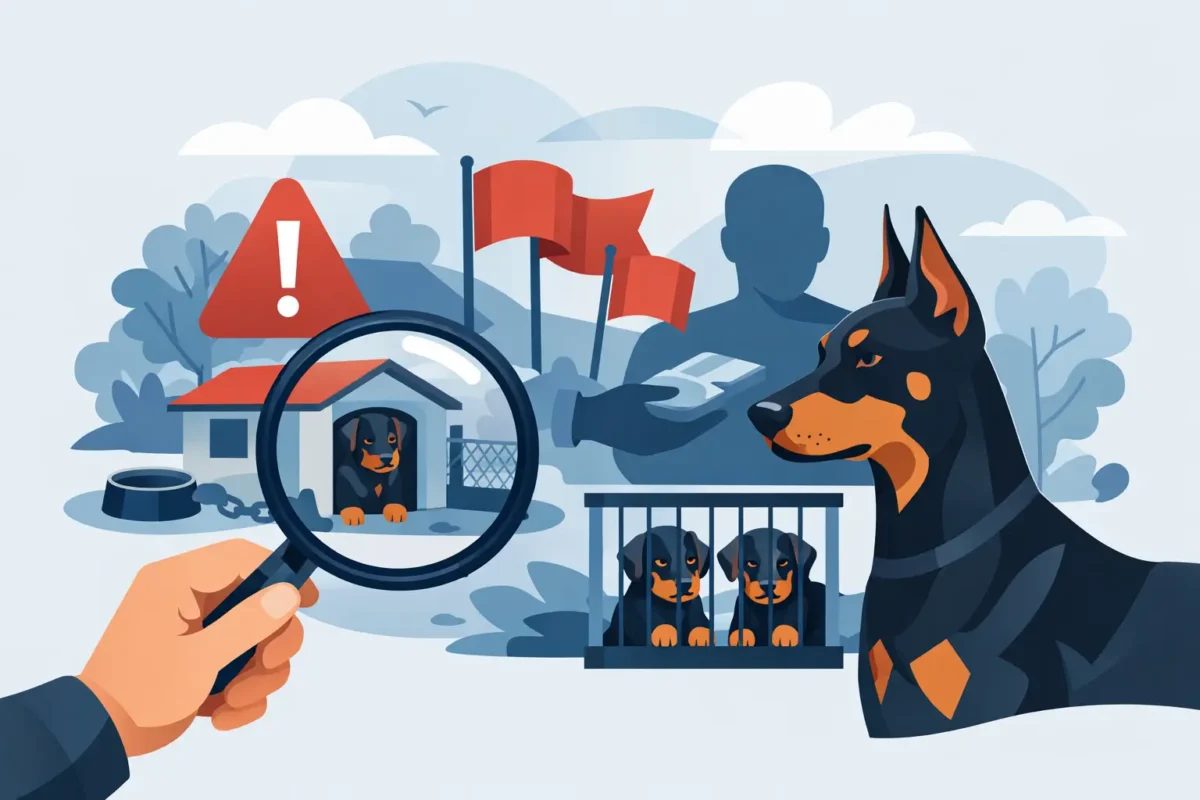
11 doberman breeder red flags to watch for
1. They cannot show meaningful health testing
This is one of the biggest warning signs. Dobermans are a breed where health screening should never be treated as optional. If a breeder talks vaguely about dogs being “vet checked” or “healthy lines” but cannot provide real documentation, that should stop the conversation.
A routine veterinary exam is not the same as breed-specific screening. Serious breeders know the difference and will be ready to discuss the health history of their lines in clear terms. If the answer feels evasive, overly defensive, or unsupported, move on.
2. They always seem to have puppies available
Quality breeding is usually limited and planned. A breeder producing litter after litter, in multiple colors or bloodlines, all year long may be prioritizing volume over quality. It does not automatically mean every high-output breeder is irresponsible, but it should make you ask harder questions.
Dobermans benefit from hands-on raising, socialization, observation, and individual care. That becomes harder to maintain when too many litters are on the ground at once. Breeding excellence is rarely built on quantity.
3. They sell on price first
A breeder should be able to explain value before price. If the main sales pitch is “cheap puppies,” “lowest deposit,” or pressure to buy fast before a deal ends, that is not the mindset you want behind a purpose-bred Doberman.
Well-bred puppies cost more because health testing, pedigree planning, quality nutrition, veterinary care, registration, and early socialization all cost more. Price matters, of course. But when low cost is the headline, corners are often being cut somewhere you cannot yet see.
4. They avoid questions about temperament
Dobermans should be confident, biddable, stable, and clear-headed. A breeder who only talks about size, color, or how protective the puppies will be is missing the heart of the breed.
Protection without stability is not an asset. It is a liability. Good breeders can describe the sire and dam in practical terms – their drives, social confidence, household behavior, working ability, and how those traits tend to show up in offspring. If the answer sounds like marketing instead of experience, be cautious.
5. The puppies are raised away from normal home life
Early environment shapes a Doberman more than many buyers realize. Puppies raised in isolation, outbuildings, or bare kennel conditions may miss critical exposure during a sensitive stage of development. That can affect confidence, adaptability, and stress response later on.
This does not mean every breeder must raise puppies in a kitchen. It does mean they should have a thoughtful socialization plan. Puppies should experience normal handling, surfaces, sounds, routines, and human interaction before they go home.
6. They will sell to anyone with money
Responsible breeders are selective. They ask questions because placement matters. A Doberman puppy should go to a home that understands the breed’s energy, training needs, intelligence, and loyalty.
If a breeder never asks about your household, schedule, experience, fencing, children, or goals for the dog, that is a red flag. Good breeders care where their puppies land. They are not trying to close a transaction. They are trying to make the right match.
7. There is no contract or health guarantee
A serious breeder stands behind the puppy in writing. That usually includes the terms of sale, registration details, health guarantee, return expectations, and spay-neuter or breeding terms when applicable.
No contract often means no accountability. On the other hand, a contract that is one-sided or vague is not much better. You want clarity, not fine print designed to disappear when a problem comes up.
8. They cannot talk confidently about pedigree
A pedigree is not just a list of names. In a well-run program, it reflects purpose, consistency, and breed knowledge. A breeder should be able to explain why a pairing was made and what strengths they hoped to preserve or improve, whether that relates to temperament, structure, working ability, or overall balance.
Champion bloodlines alone do not guarantee quality. Titles matter, but they are only part of the picture. The breeder should understand the dogs behind the paperwork, not just repeat impressive names.
9. They push color or extreme traits too hard
Buyers often have preferences, and that is understandable. But when a breeder markets rare looks, oversized frames, or exaggerated traits as the main attraction, that is often a sign of misplaced priorities.
Dobermans should be bred for total quality, not novelty. Extreme size, poor structure, unstable nerves, or flashy selling angles may attract attention online, but they do not serve the breed or the family bringing the puppy home.
10. They discourage visits, video calls, or real transparency
Some breeders have reasonable biosecurity rules, especially with young litters. That is valid. But there is a difference between careful protocols and complete opacity.
If a breeder refuses to show where puppies are raised, will not schedule a call, avoids showing the dam, or seems to hide basic details, trust your instincts. Reputable breeders usually welcome informed buyers because they have nothing to hide.
11. Support ends after payment
The relationship should not disappear once the puppy leaves. Doberman owners, especially first-time owners, benefit from guidance on feeding, training, crate transition, ears, socialization, and adolescent development.
A breeder who vanishes after pickup is signaling that the puppy was a product, not a lifelong responsibility. The right breeder remains a resource because they care how the dog matures in the real world.
What a trustworthy breeder usually does differently
The safest breeders are rarely the loudest marketers. They are the ones who answer questions thoroughly, provide documentation without hesitation, and speak with real pride about their dogs beyond surface traits. They know their lines. They know what they are producing. And they understand that every Doberman puppy they place carries their name forward.
In a strong breeding program, health testing is standard, not a bonus. Puppies are raised with intention. Temperament is discussed honestly, including trade-offs. Some lines may have more working drive. Some may be better suited for active family homes than novice handlers. That kind of honesty is a good sign, not a sales weakness.
You should also expect structure in the buying process. Thoughtful breeders use contracts, ask buyers meaningful questions, and explain what support comes after placement. At Macson’s Doberman, that breeder-guided approach reflects what serious families are actually looking for – not just a puppy, but confidence in the program behind it.
How to use these red flags without becoming overly suspicious
Not every awkward conversation means a breeder is irresponsible. Some excellent breeders are more direct than polished. Some keep small websites but run outstanding programs. Others may have limited social media and still maintain exceptional standards. The goal is not to look for perfection. It is to look for consistency, transparency, and proof.
When something feels off, ask one more question. If the answer gets clearer, that is useful. If the answer gets slippery, defensive, or rushed, that tells you even more. Buying a Doberman should feel serious, informed, and steady – not pressured or confusing.
A great breeder will not need gimmicks to earn your trust. They will show you, in the health of their dogs, the quality of their planning, and the way they prepare each puppy for the life ahead. That is the kind of foundation worth waiting for, because the right start shapes the companion and protector you will live with for years.
