
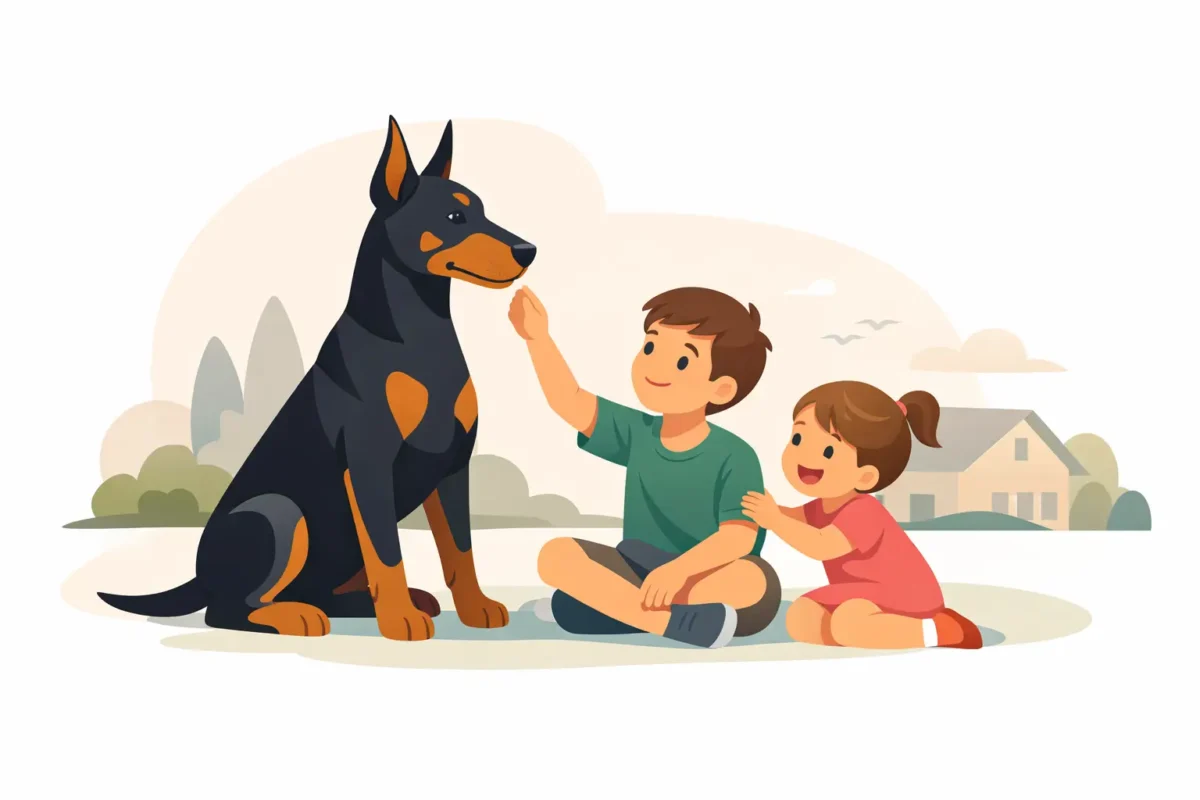
If you have children in the home, this question matters more than almost any other: are dobermans good with kids? The honest answer is yes, they can be excellent family dogs – but not by accident. A Doberman’s behavior around children comes from temperament, breeding, early socialization, training, and the structure of the home they join.
That matters because Dobermans are not casual dogs. They are intelligent, alert, emotionally tuned in, and naturally protective. In the right hands, those traits make them deeply devoted family companions. In the wrong environment, or when bred without care for stability, those same traits can become difficult to manage.
Are Dobermans Good With Kids by Nature?
A well-bred Doberman is typically loyal, affectionate with its people, and highly aware of the family unit. Many Dobermans form especially strong bonds with children in the home and become steady, watchful companions. They are often more gentle with their own family than people expect from such a powerful breed.
Still, breed reputation alone is not enough. Dobermans are athletic, strong, and quick to react. A dog with poor nerves, weak socialization, or inconsistent boundaries is not automatically a good match for young children just because it is a Doberman. That is why serious breeders place so much emphasis on stable temperament, health testing, and early home rearing.
A good Doberman should not be nervy, chaotic, or unpredictable. It should be confident, clear-headed, and biddable. Those qualities are what make family life work.
What Makes a Doberman Safe Around Children?
The biggest factor is temperament. Children need a dog that can tolerate movement, noise, and the everyday unpredictability of family life without becoming overwhelmed. A Doberman with sound temperament can settle in the house, read the room, and respond to guidance. That is very different from a dog that startles easily or becomes overstimulated.
Early socialization also matters. Puppies that are raised in a home environment, handled properly, exposed to normal sounds, and introduced to age-appropriate experiences tend to adapt more smoothly to family life. They learn that human activity is normal. They build confidence early rather than fear.
Training is the next piece. Dobermans are highly trainable, which is one of their greatest strengths. They learn house rules quickly when expectations are clear. Basic obedience, leash manners, place training, and impulse control go a long way in a home with kids. A large, energetic dog does not need to be harsh to cause problems. Even friendly excitement can knock over a toddler.
Then there is supervision. No dog, no matter how trustworthy, should be treated like a babysitter. Children also need instruction. They should learn how to approach, pet, and respect a dog’s space. The best child-dog relationships are managed from both sides.
Age of the Child Makes a Difference
Families often ask for a simple yes or no, but age changes the answer.
With older children, Dobermans often do beautifully. School-age kids and teens can participate in training, understand boundaries, and interact in a calmer, more consistent way. A Doberman often thrives when it has a real bond with children who are active, respectful, and engaged.
With toddlers and very young children, more caution is needed. This does not mean the match is wrong. It means management must be stronger. Young kids move unpredictably, grab at ears, fall on dogs, and make sudden noise. Even a very loving Doberman may become stressed if those interactions are not guided carefully.
For families with babies or toddlers, the question is less whether the breed can work and more whether the adults are prepared to lead the relationship every day.
Why Breeding Matters More Than People Realize
When people ask whether Dobermans are good with kids, they are often really asking whether they can trust the individual puppy they bring home. That trust begins long before pickup day.
Responsible breeding is not just about appearance or paperwork. It is about preserving the character of the breed. Health screening helps reduce inherited problems. Thoughtful pairings help maintain sound structure and stable nerves. Limited, intentional litters allow each puppy to be handled and evaluated properly.
A family looking for a child-friendly Doberman should care deeply about where the puppy comes from. Poor breeding can produce unstable temperaments, excessive fear, weak recovery, or unnecessary sharpness. Those are not traits families should gamble on.
At Macson’s Doberman, we believe a family companion should still reflect the true breed standard – elegant, loyal, intelligent, and clear-headed. Protection instinct without stability is not quality. A Doberman meant for a home with children should have both heart and control.
Common Concerns Families Have
One concern is size and strength. This is fair. Dobermans are medium-large dogs with real power behind them. A young dog in adolescence can be exuberant, and families need to be ready to guide that stage instead of being surprised by it.
Another concern is protectiveness. Properly balanced protectiveness is one reason many families love the breed. A sound Doberman is naturally aware and devoted without being unstable or indiscriminately reactive. The goal is a dog that is confident and discerning, not suspicious of every normal guest or neighborhood child.
Some families also worry that Dobermans are too intense for a home. The truth is that intensity cuts both ways. A Doberman needs engagement, training, and connection. In return, it offers remarkable loyalty and responsiveness. For active households that want a dog involved in daily life, this can be a tremendous fit.
How to Raise a Doberman That Does Well With Kids
Success starts early and continues consistently. Bring structure into the home from day one. Teach the puppy where to rest, how to greet calmly, and how to respond to simple commands. Reward calm behavior around children instead of only reacting when the puppy gets too excited.
Children should also be given clear rules. No climbing on the dog, no cornering it during meals, no disturbing it while resting, and no rough teasing disguised as play. Respect builds trust.
Exercise is another major piece. A Doberman with pent-up energy is harder to manage around children. Physical activity, training sessions, and mental work help the dog settle and make better choices inside the home. A balanced Doberman is not just tired. It is fulfilled.
Families do best when they think long term. Puppyhood is charming, but adolescence is where consistency is tested. This breed matures with guidance, not guesswork.
Are Dobermans Good With Kids in Every Home?
Not every home is the right Doberman home, and saying that honestly helps families make better choices.
If a household wants a very low-maintenance dog, a Doberman may feel demanding. If adults do not have time to train, supervise, and stay involved, the breed can become frustrating. If children are extremely rough and the home has little structure, that is not ideal for any serious working breed.
On the other hand, if the family wants a loyal companion, values obedience and stability, and is committed to raising the dog properly, a Doberman can be one of the most rewarding breeds to live with. Many become deeply attached to the children they grow up with and take that bond seriously.
That is the side of the breed experienced owners know well. Behind the proud outline and guardian instinct is a deeply devoted dog that wants to be close to its people.
The Real Answer for Families
So, are dobermans good with kids? Yes – when they are well bred, properly socialized, thoughtfully trained, and placed in a home that respects both the dog and the children. They are not the right choice for every family, but in the right environment they can be affectionate, watchful, and exceptionally loyal.
The smartest families do not shop by stereotype alone. They ask about health, temperament, socialization, and breeder support. They prepare their home, set expectations early, and choose a puppy with care.
If you want a dog that combines elegance, intelligence, devotion, and natural protectiveness, a Doberman can be a remarkable addition to family life. The best outcomes come from starting with the right puppy and raising that puppy with purpose.
