
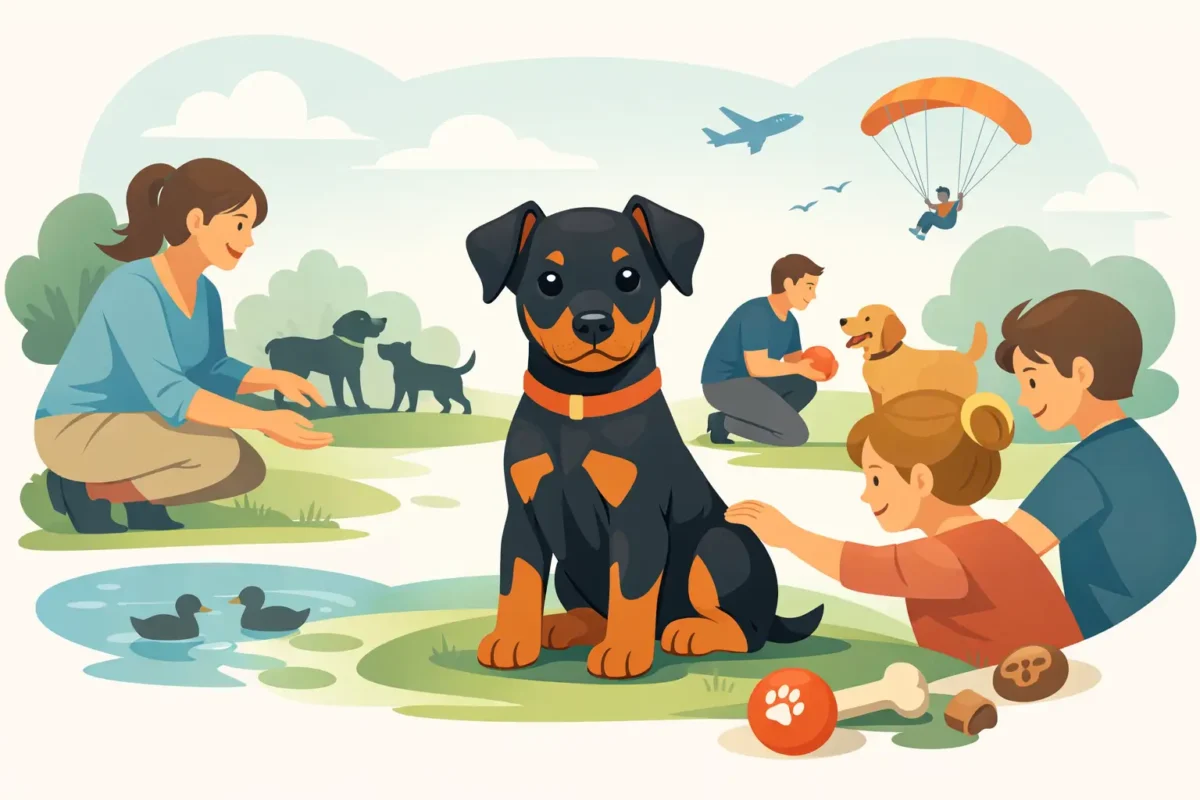
A confident Doberman does not happen by accident. This breed is intelligent, observant, deeply loyal, and quick to read its environment. That is exactly why a doberman puppy socialization guide matters so much. Early experiences shape whether your puppy grows into a calm family companion and steady protector or becomes uncertain, reactive, and harder to manage than the breed should ever be.
For Dobermans, socialization is not about making them love every stranger or ignore every sound. It is about teaching them what is normal. A well-socialized Doberman learns to move through the world with composure. That means meeting new people without panic, seeing other dogs without overreacting, hearing household noise without stress, and recovering quickly when something unfamiliar appears.
Why socialization matters so much in Dobermans
Dobermans are not a casual breed. They are sensitive, highly trainable, and naturally aware of changes around them. Those are excellent traits when they are developed correctly. They are not excellent traits when a puppy grows up sheltered, overstimulated, or exposed to the wrong things at the wrong pace.
A poorly socialized Doberman can become suspicious in ways owners did not intend. People sometimes confuse that with protectiveness, but they are not the same. True stability is a dog that can assess, pause, and respond with confidence. Fear-based behavior is different. It often looks like lunging, barking, avoidance, or constant tension. That is why breeders who take temperament seriously put strong emphasis on early handling and structured exposure.
Socialization also supports every future role your Doberman may have. Whether you want a loyal family dog, a personal protection prospect, a performance companion, or a beautiful, mannerly house dog, confidence is the foundation. Without it, training becomes harder and trust becomes fragile.
The right window for a doberman puppy socialization guide
The most important socialization period begins very early and continues through the first several months of life. Puppies are especially open to new experiences during this stage, but that does not mean they should be flooded with everything at once. Good socialization is controlled, positive, and thoughtful.
The goal is not quantity alone. Meeting fifty people in one loud afternoon is not automatically better than meeting five calm, respectful people in a way that leaves your puppy feeling secure. With Dobermans, quality matters. This breed tends to remember pressure, so owners need to focus on positive exposure rather than forced interaction.
Once your puppy comes home, the work continues daily. The early breeder foundation is valuable, but the owner shapes what happens next. Consistency at home is what turns promising temperament into lasting temperament.
What proper socialization really looks like
Socialization is broader than many first-time owners expect. It includes people, dogs, sounds, surfaces, routines, handling, movement, and the simple act of settling in new places.
Your Doberman puppy should gradually experience adults of different ages and appearances, children who can behave appropriately, friendly vaccinated dogs, car rides, crates, leashes, doorbells, vacuum noise, grooming routines, vet-style handling, stairs, slick floors, grass, gravel, and everyday activity around the home. Just as important, your puppy should learn that not every new person needs direct contact. Calm observation is part of socialization too.
That last point matters with this breed. A Doberman does not need to be passed around by strangers to become stable. In fact, too much forced attention can create discomfort. A better standard is this: your puppy notices something new, stays composed, and either investigates willingly or remains neutral. That is success.
How to socialize without creating fear
Pace matters. If your puppy freezes, hides, startles hard, or begins refusing treats, the situation is probably too intense. Back up, lower the pressure, and let the puppy recover. Socialization should stretch confidence, not crush it.
Use food, praise, play, and distance to your advantage. If a new place is busy, begin from the edge rather than the center. If a visitor wants to greet your puppy, ask them to stay calm and let the puppy choose whether to approach. If your puppy is unsure about a surface or sound, avoid dragging or cornering. Encouragement works better than force.
There is also a trade-off owners need to understand. You want exposure, but you also want health safety while vaccination schedules are still in progress. That means being smart. Carry your puppy in certain public places, invite healthy dogs you know well, use clean environments, and ask your veterinarian where the safest opportunities are in your area. Socialization should start early, but it should not ignore common-sense disease prevention.
Everyday routines that build a stable Doberman
The best socialization often happens in short, ordinary moments. A puppy that calmly watches the mail carrier from your arms, hears pots clatter in the kitchen, rides quietly in the car, and rests in a crate while the house moves around them is learning valuable skills.
Practice gentle handling every day. Touch ears, paws, mouth, collar area, and tail in a calm way, then reward. This helps with future grooming, nail care, veterinary exams, and general trust. Dobermans are deeply aware dogs. When they learn early that human hands are predictable and safe, they become easier to manage in every stage of life.
Teach recovery as much as exposure. If your puppy hears a new sound and startles, what happens next matters. Encourage a reset. Offer a cheerful voice, a treat, or a simple known behavior. Confidence is not the absence of surprise. It is the ability to bounce back.
Common mistakes Doberman owners make
One mistake is waiting too long. Some owners decide they will start after all vaccinations are complete, but by then valuable time has already passed. Another is assuming socialization means dog parks, crowded stores, and nonstop greetings. For many puppies, especially Dobermans, that much intensity is too much too soon.
A third mistake is rewarding clinginess by overprotecting the puppy from every challenge. Your Doberman should feel supported, not sheltered. There is a balance between safety and exposure. You do not want to throw a puppy into chaos, but you also do not want to raise one that has never seen the world.
Owners also sometimes mistake sharpness for strength. A nervous puppy that barks at everything is not showing promising guardian instincts. More often, that puppy is communicating insecurity. A strong Doberman is clear-headed, trainable, and composed.
How breeder foundation changes the outcome
Socialization begins before a puppy ever leaves for a new home. Puppies raised in a hands-on environment, exposed to normal household life, gently handled, and observed closely tend to transition better. They often show stronger recovery, better curiosity, and more natural trust.
That foundation is one reason quality breeders matter. At Macson’s Doberman, structured early care is part of producing puppies with the temperament families can live with and rely on. Pedigree and health matter greatly, but how a puppy is raised during those first weeks matters too.
Even with a strong start, placement matters. A high-potential puppy still needs an owner who will continue the work. Socialization is not a one-week task. It is a habit of shaping experience.
A practical timeline for the first months
During the first days at home, focus on security, routine, and gentle exposure. Let your puppy learn the household rhythm, meet immediate family members, experience the crate positively, and begin short car rides and calm handling.
Over the next several weeks, expand carefully. Introduce new people, varied environments, safe dog interactions, and simple outings where your puppy can observe the world without being overwhelmed. Keep sessions short and end on a good note.
As your Doberman grows, continue reinforcing neutrality and confidence. Adolescence can bring temporary sensitivity, and some puppies that seemed easy at first may become more cautious. That is normal. Stay consistent. Revisit familiar exposures, add new ones gradually, and keep training clear and fair.
The goal is not a social butterfly
Many owners make better decisions once they stop aiming for the wrong picture. A great Doberman does not need to act like a breed that welcomes everyone with instant enthusiasm. That is not the standard. The standard is steadiness.
You want a dog that can live in the real world with confidence, think before reacting, accept guidance, and remain trustworthy around family, guests, and everyday situations. For this breed, that is the mark of strong socialization.
If you approach those early months with patience, structure, and respect for the breed’s nature, your puppy has every chance to mature into what a Doberman should be – elegant, dependable, and sound in mind as well as body. Give your puppy the world in measured, positive pieces, and you will be building more than good manners. You will be building character.
